Eliza Ann Wade
Written as “Mother”, “Ma”
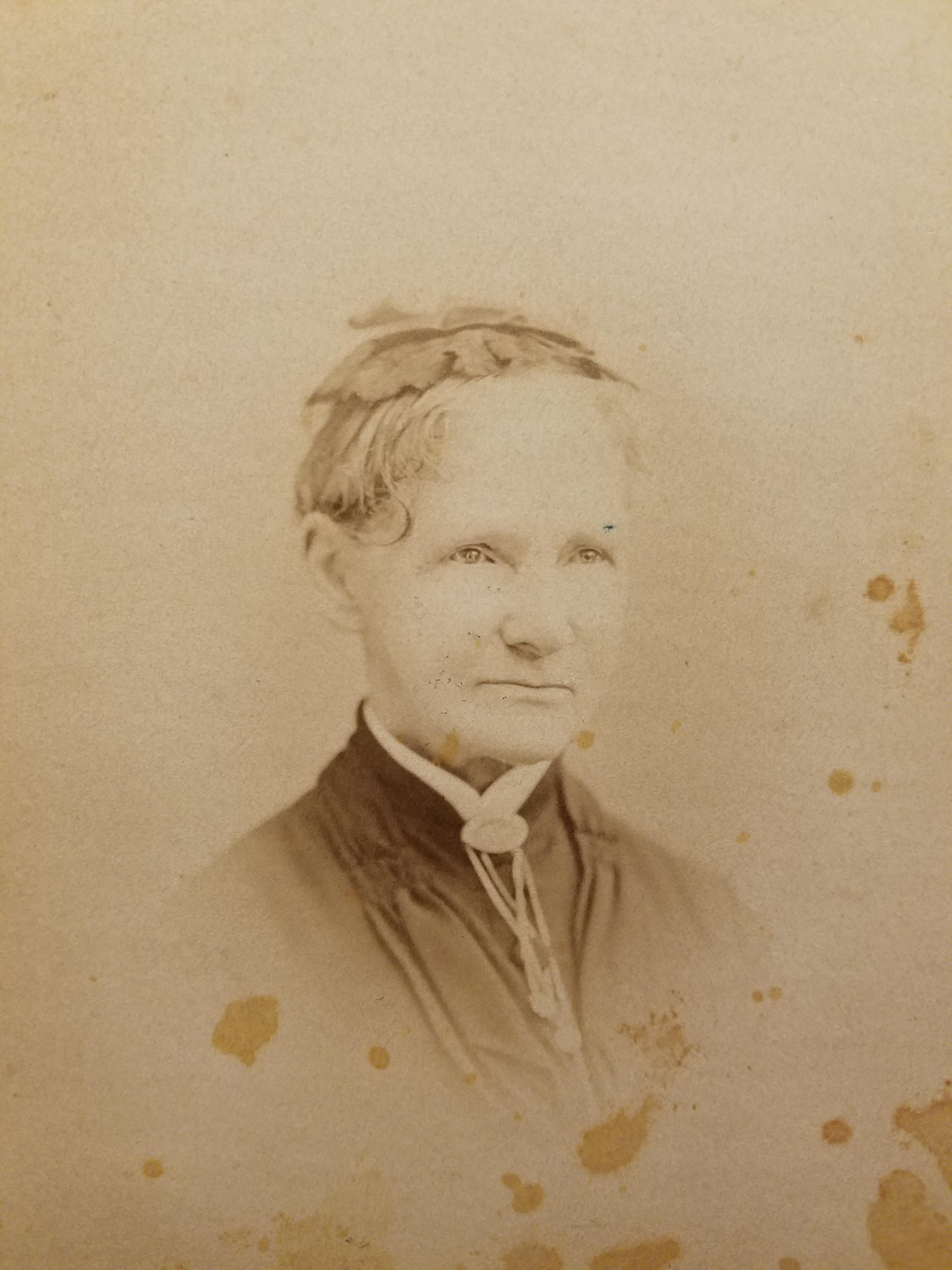
Eliza Ann Wade was born on Gold Street in Manhattan on March 1, 1816, “when that section of the city north of Canal street was all farming land”. She was the daughter of John and Mary Elizabeth Wade, and her ancestors “were of old English stock” (Brooklyn Daily Eagle, December 16, 1915, p. 1). Her death certificate names her father as John Wade, born in New York City (the 1855 census gives England), and her mother as Mary Hickey, born on Long Island (New York City certificate of death No. 23363, 1915), and her son John’s marriage certificate gives his mother’s maiden name as “Eliza A. Wade” (Brooklyn certificate of marriage No. 1490, 1876). Her father was probably the John Wade, 78, listed as “Father” in her household in 1855 (1855 New York State census), who died, aged 79, at her husband’s house, 66 Ninth Street, Williamsburgh, early in January 1856; he had been “a constituate member” of the Baptist church in McDougal Street, New York (Brooklyn Daily Times, January 4, 1856, p. 2). As a girl she went with her parents to the old Gold Street Baptist Church, and later to the old Oliver Street Baptist Church (Brooklyn Daily Eagle, December 16, 1915, p. 1). She married James M. Wade, came to Brooklyn in 1845 (Times Union, December 16, 1915, p. 6), and lived for many years in Williamsburgh, “where her late husband was a well-known builder and real estate broker” (Brooklyn Daily Eagle, December 16, 1915, p. 1).
She had six children, and “one daughter and one son died in their early childhood” (Brooklyn Daily Eagle, March 3, 1914, p. 13). The 1850 census lists five of them, James, William, Washington, John and Sophia, and Durlyn was born in 1853. Washington and Sophia appear only in 1850, and are probably the two who died young (1850; 1855; 1865). Her four surviving sons were James, William, John and Durlyn.
During the war she kept the family home at 183 South 6th Street, Williamsburgh (James to Mother, January 17, 1864), and managed the money her sons sent. James told her to “take out and keep for your own use five dollars a week” (same letter), to take $20 a month “for the use of the family” (James, January 18, 1864), and to “make use of my money in getting furniture and clothes and making yourself comfortable in general” (James, February 21, 1864).
One of her own letters survives, added to Willie’s letter to James in December 1863. It tells James that Willie was home, describes the day the three-year men were separated from the rest (“The men that were kept wept like children”), reports the Sunday-school teachers’ rush to ask after him, and closes, “May God watch over you for good is the prayer of your Parents” (Mother to James, December 27, 1863). Her sons’ letters show what hers meant to them. “As for you, Mother, why I could not get along without your letters at all; you are the principal inducement to come home. I never knew I loved Mother so much until I came to this country,” James wrote (James, October 19, 1863). He imagined walking “up the isle to our pew with Mother’s arm in mine, with my uniform on” (James, April 13, 1864). Willie brought James’s shells home, “which Mother highly appreciated” (Willie to James, December 27, 1863).
In 1874 she helped found a church. She, her husband and her sons John and Durlyn attended the first conference on organizing it, on October 31, 1874, and Trinity Baptist Church “organized December 18, 1874, at the home of James M. Wade, 10 Kossuth place” (Brooklyn Daily Eagle, October 10, 1912, p. 7). She was widowed in 1876 (Brooklyn Daily Times, April 5, 1876, p. 3). When Trinity dedicated its new building at Greene and Patchen avenues in October 1912, the pastor had planned for her, at 96, to offer the prayer of dedication. An accident kept her at home, so “she wrote out the prayer which she had intended to offer, and it was read at the services” (Brooklyn Daily Eagle, October 11, 1912, p. 11).
She remembered the New York of her girlhood, “when the present City Hall was considered ‘far uptown’”, and she took part in the reception for General Lafayette “on his visit here from France”, where she shook hands with him; she “was able to describe minutely everything that happened at that occasion” (Brooklyn Daily Eagle, March 3, 1914, p. 13; Brooklyn Daily Eagle, December 16, 1915, p. 1). She also recalled crossing the East River on one of the first steam ferryboats (Brooklyn Daily Eagle, December 16, 1915, p. 1). When she turned 99, about a hundred guests and four generations of her family came to a reception at John’s house; her granddaughter Adele helped her receive them, and her pastor, the Rev. Lew Wallace of Trinity Baptist Church, “was one of the early arrivals” (Brooklyn Daily Eagle, March 2, 1915, p. 7). At 98 she was “still hale and hearty”, “a trifle deaf”, and read “religiously,” as she put it, “the Monday night sermon page of the Eagle” (Brooklyn Daily Eagle, March 3, 1914, p. 13). Until her last week she “read the newspapers every day, knit, sewed and made patchwork quilts” (Brooklyn Daily Eagle, December 16, 1915, p. 1).
For her last fifteen years she made her home with her only surviving son, Dr. John E. Wade, at 908 Greene Avenue. She died there at 1 p.m. on December 15, 1915, “aged 99 years, 9 months”, of broncho-pneumonia after an illness of only a week, with old age as a contributing cause; her son John attended her and signed the certificate (certificate of death No. 23363; Brooklyn Daily Eagle, December 16, 1915, pp. 1 and 18). The Rev. Dr. Maurice Ambrose Levy of the Greene Avenue Baptist Church conducted the funeral at the house, and “only the immediate relatives attended the burial in the family plot in Cypress Hills Cemetery” (Brooklyn Daily Eagle, December 19, 1915, p. 54; Find a Grave). She left her son, several grandchildren and six great-grandchildren (Brooklyn Daily Eagle, December 16, 1915, p. 1).
- From Eliza Ann Wade 1
- 1863 Dec 27
- Mentioned in 1
- 1863 Dec 27